
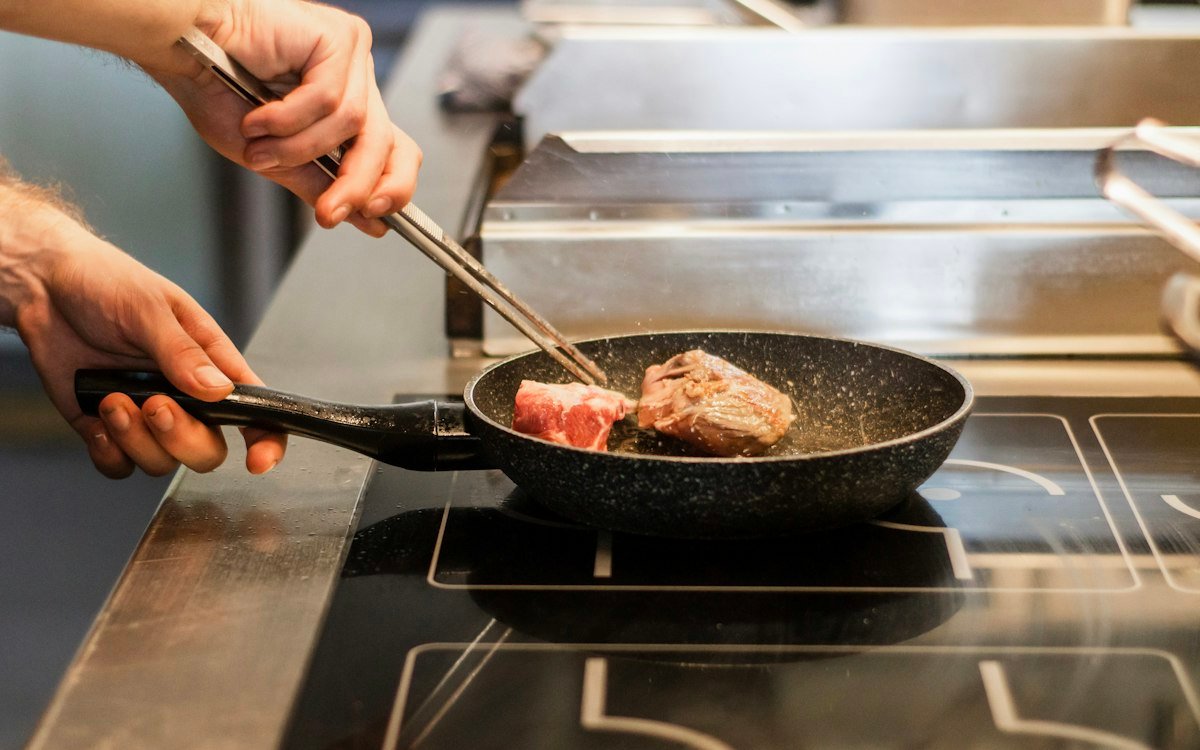
A non-stick pan is the one piece of cookware most people replace more often than they expected to. It is rarely because the pan was cheap. It is usually because of how the coating was treated in the first six months.
What the coating actually is
Almost every non-stick pan sold today uses a PTFE-based coating — the material most people know by a brand name. It is a fluoropolymer sprayed onto the pan in layers and cured. More layers generally means a longer life, which is why a pan described as having a "three-layer" or "reinforced" coating usually outlasts a single-layer one.
Ceramic non-stick is a different material: a silica-based sol-gel coating. It releases food well when new and is often marketed as the healthier option. In practice its release performance falls off faster than PTFE, typically within a year or two of regular use.
Neither coating is permanent. A non-stick pan is a consumable in a way that a stainless or cast iron pan is not, and it is worth buying with that in mind.
The base matters more than the coating
A thin pan will warp, and a warped pan cooks unevenly no matter how good the coating is. Look for:
- Thickness. A heavier pan of the same diameter almost always has more aluminium in the base. Weight is a reasonable proxy when you cannot see a specification.
- A clad or disc base if you use induction. Non-stick aluminium is not magnetic, so induction pans have a steel plate bonded to the bottom.
- A flat base. Put it on a flat surface and press an edge. Any rock means it will spin on a hob.
Handles and oven use
An oven-safe rating is only as good as its weakest part. A pan rated to 260°C with a plastic handle is rated for the pan, not the handle. Riveted metal handles last longer than screwed ones, but rivets sit inside the pan and interrupt the cooking surface slightly. Neither is wrong; it is a trade between longevity and a clean interior.
What kills a non-stick pan
Most non-stick failures come from four things, and all four are avoidable:
- High heat with an empty pan. PTFE begins to degrade above roughly 260°C, and an empty pan on a high burner passes that in a couple of minutes. Always add fat or food before the pan is hot.
- Metal utensils. Even a careful cook scores the coating eventually. Wood, silicone or nylon costs nothing to switch to.
- The dishwasher. Many pans are labelled dishwasher-safe. Detergent is abrasive and alkaline, and repeated cycles dull the coating faster than hand washing.
- Stacking. Pans stored inside each other grind their coatings together. A cloth or a pan protector between them solves it.
Sizes worth owning
Most households do better with two pans than one large one. A 20cm pan handles eggs and single portions without needing much oil to cover the surface. A 26–28cm pan handles a meal for two to four. A single 30cm pan is unwieldy for small jobs and encourages using more fat than needed.
When to replace it
Replace a non-stick pan when food sticks despite fat and correct heat, or when the coating is visibly scratched through to the metal, flaking, or bubbled. A worn coating does not become dangerous so much as useless — but flaking is the point at which it stops being a cooking surface.
Expect three to five years from a well-treated mid-range pan, and one to two from a thin one used on high heat.
The short version
Buy for base thickness first, coating layers second, and handle construction third. Then treat it as the consumable it is: moderate heat, soft utensils, hand washing, and nothing stacked inside it. That single change in habit does more for a pan's life than doubling the budget.
More cookware notes are filed under Home & Kitchen.