
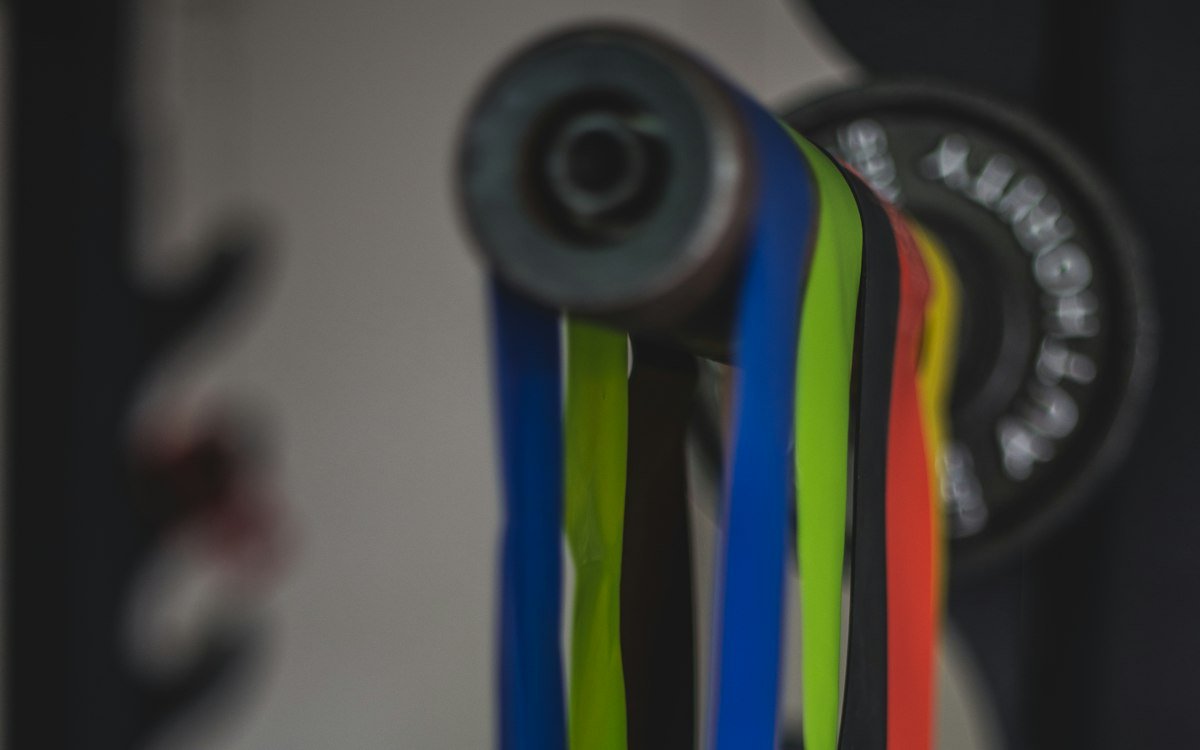
Resistance band colours look like a standard. They are not. Red is light in one brand and heavy in another, and there is no industry agreement behind any of it.
There is no universal colour code
Manufacturers choose their own sequences. A common pattern runs yellow, red, green, blue, black from lightest to heaviest — but plenty of brands reverse parts of it, and physiotherapy bands use a different progression again.
The practical consequence: colour tells you the order within one set, and nothing across sets. Replacing a lost band with the same colour from another brand will not give you the same resistance.
What you should look for on the packaging is a figure in kilograms or pounds. If a band is sold with no resistance figure at all, the colour is the only information you have and it is not transferable.
Why the resistance figure is itself approximate
A band's resistance is not fixed. It increases as the band stretches, which is the fundamental difference between bands and weights.
A dumbbell weighs the same at the bottom and the top of a curl. A band pulls hardest at the point of greatest stretch. So "15kg" on a band means roughly fifteen kilograms at some particular extension — usually around two and a half or three times its resting length, though brands rarely say which.
That is why two bands both labelled 15kg can feel different, and why the same band feels much harder when you stand further from the anchor.
The three formats, and what each is for
Loop bands (mini bands). Short continuous loops, usually fabric or latex. Worn around the thighs or ankles for glute and hip work, warm-ups, and lateral movements. The fabric ones do not roll up on the leg; the latex ones are cheaper and do.
Long loop bands (pull-up bands). Large continuous loops, typically 2m. Used for assisted pull-ups, for adding resistance to barbell lifts, and for stretching. These are the ones with the widest resistance range, and width correlates with strength across a single brand.
Tube bands with handles. A latex tube with grips at each end and usually a door anchor. Closest to a cable machine, and the most versatile for pressing and rowing. The handles and clips are the parts that fail.
Reading width on long loop bands
For long loop bands, width is a more reliable indicator than colour within a brand. Common widths and rough ranges:
| Width | Typical range |
|---|---|
| 13mm | 2–15kg |
| 21mm | 7–25kg |
| 32mm | 15–40kg |
| 45mm | 20–55kg |
| 64mm | 30–80kg |
The ranges are wide because of the stretch point problem above. Treat them as orders of magnitude.
The progression problem
Bands do not offer small increments. A set might jump from 7kg to 16kg with nothing between, which is a much larger step than you would ever take with dumbbells.
Two ways round it:
- Stack bands. Two light bands together give a resistance between one light and one heavy, and stacking is how most people actually progress.
- Change your distance from the anchor. Standing further away pre-stretches the band and raises resistance throughout the movement. This is a continuous adjustment, and it is the band's real advantage over fixed weights.
Latex, and when it fails
Most bands are natural latex. Two things to know:
Latex allergy. Some people react to natural latex. TPE and fabric bands exist for this reason, and fabric loop bands are usually latex-free — check, because some have a latex core.
They degrade. Latex breaks down with UV light, heat, oil and ozone. A band stored in a sunny window or a hot car will crack within months. Signs to retire one: small surface cracks, a shiny worn patch, any nick in the edge, or a change in feel.
A band failing under load snaps back toward whatever is holding it. Never stretch one toward your face, and check a pull-up band before you hang from it.
Care
Keep them in a drawer or a bag, not on a hook in the sun. Rinse sweat off occasionally and dry fully. Do not use them over rough concrete or on a door anchor with a sharp edge, which is the usual place a band gets its first nick.
More training notes are filed under Health & Fitness.